Our Location
304 North Cardinal St.
Dorchester Center, MA 02124

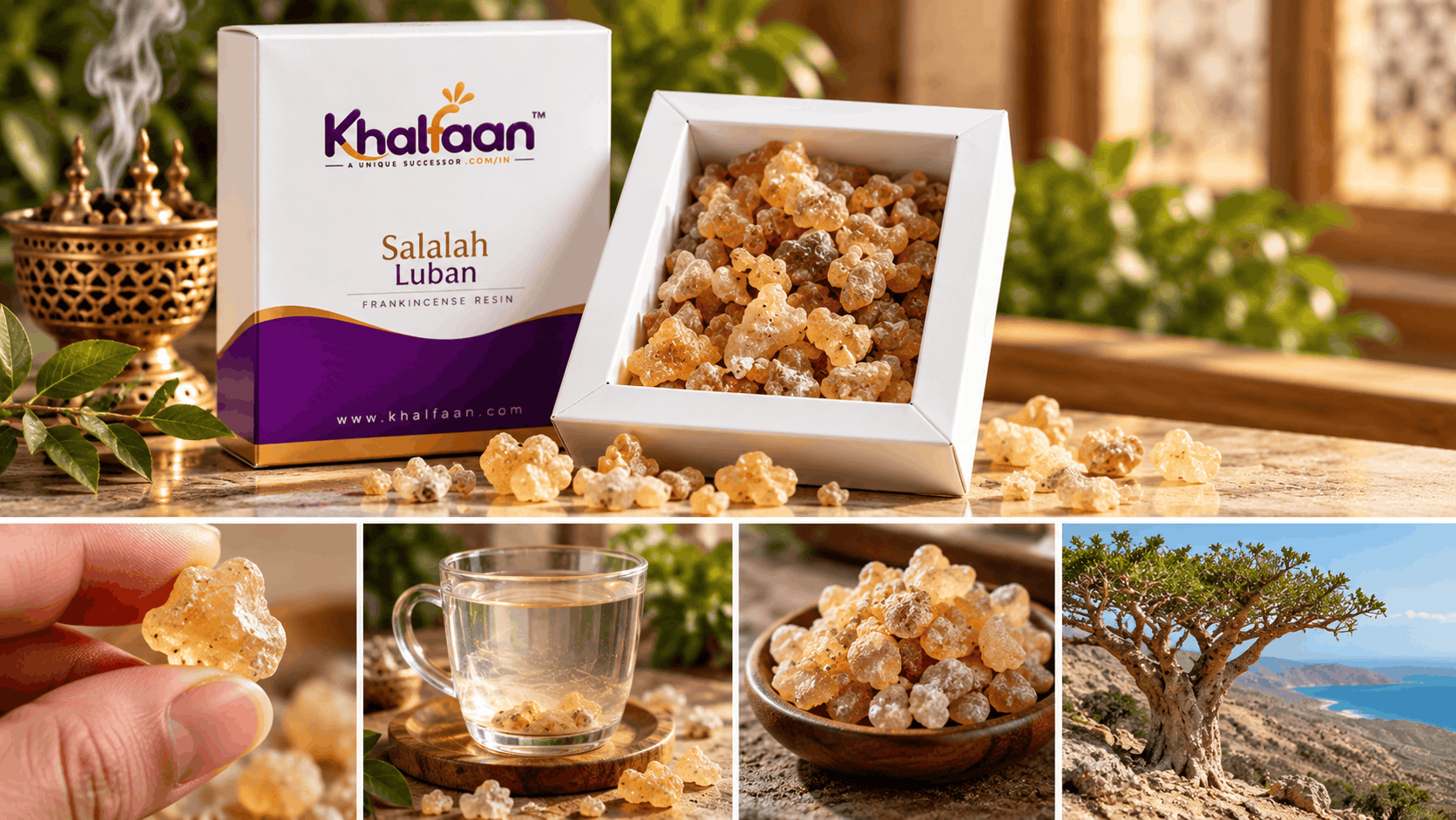
Discover the story of Omani frankincense, its unique aroma, traditional chewing and drinking-water practices, and the natural heritage behind Khalfaan Salalah Luban.
Some of nature’s most interesting treasures don’t look extraordinary at first glance.
Salalah Luban is one of them.
These small, golden and pale amber resin pieces may look like tiny crystals, but they carry a story that goes back thousands of years.
Known as Luban in Arabic and frankincense in English, this aromatic tree resin has been treasured across the Arabian Peninsula for generations.
In Oman, particularly in the Dhofar region around Salalah, frankincense is more than a traditional fragrance. It is part of the country’s history, hospitality and cultural identity.
It has been burned as incense, chewed in traditional settings and infused in water as part of local customs.
Today, Khalfaan Salalah Luban introduces customers to this fascinating natural product and the traditions surrounding it.
Salalah Luban is a natural aromatic resin obtained from frankincense trees.
The Omani frankincense tree is scientifically known as Boswellia sacra.
These trees grow in the dry landscapes of southern Oman, especially the Dhofar region.
To collect frankincense, harvesters make careful cuts in the tree’s bark. A milky substance emerges and gradually hardens into small resin tears.
After collection, the resin may be sorted according to its appearance, quality and intended use.
Natural frankincense varies in colour, from pale and translucent to golden, amber and darker shades.
Its characteristic aroma can be woody, citrus-like, balsamic and slightly spicy.
Salalah, in southern Oman, is closely connected with the history of frankincense.
For centuries, traders transported this valuable resin from the Dhofar region to distant markets.
It travelled along ancient caravan routes and through maritime trading ports.
Frankincense was valued for its fragrance, ceremonial importance and use in traditional preparations.
Its significance was so great that several historic sites connected with the trade are now recognized as the UNESCO World Heritage Site known as the Land of Frankincense.
These include Wadi Dawkah, Al-Baleed, Khor Rori and Shisr.
When you hold a piece of Salalah Luban, you’re holding a natural material with a connection to one of Arabia’s oldest trading traditions.
Frankincense has been associated with several traditional wellness practices.
But it’s important to distinguish between traditional beliefs and benefits that have been confirmed through scientific research.
In some traditional practices, frankincense resin or frankincense-infused water has been used after meals.
People have historically associated it with digestive comfort.
However, clinical evidence is insufficient to confirm that drinking Salalah Luban water improves digestion or treats digestive conditions.
Chewing suitable frankincense resin is a traditional practice in parts of the Middle East.
As the resin softens, it releases its characteristic aromatic flavour.
Some people enjoy it as a natural chewing tradition.
However, it should not be treated as a replacement for brushing, flossing or professional dental care.
Researchers have studied compounds found in several Boswellia species for their possible anti-inflammatory properties.
Some studies of standardized Boswellia extracts suggest potential benefits for certain inflammatory conditions.
However, these findings do not establish that chewing raw Omani frankincense or drinking resin-infused water produces the same effects.
One of the best-known uses of frankincense is its fragrance.
The warm, resinous aroma is closely associated with traditional Arabian homes, hospitality and ceremonial occasions.
Many people enjoy the scent because it creates a pleasant atmosphere.
That is a sensory experience rather than proof of a medical benefit.
Perhaps the most certain benefit of Salalah Luban is its cultural value.
It connects today’s customers with traditional Omani craftsmanship, natural materials and centuries of history.
Salalah Luban has several traditional uses.
The correct method depends on whether the resin is intended for consumption, incense or another purpose.
Important: Only use resin for eating, chewing or drinking-water preparation if the specific product is verified and labelled as food-grade and suitable for consumption. Not all frankincense sold for incense is edible.
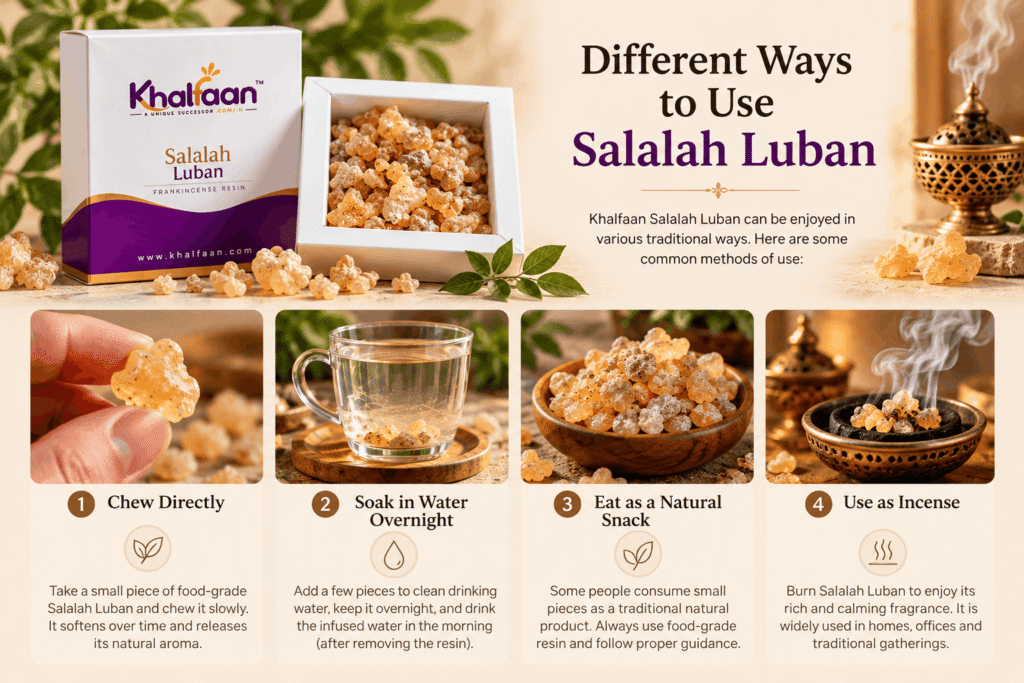
One traditional method involves chewing a small piece of suitable frankincense resin.
Unlike ordinary chewing gum, the resin begins hard and may gradually soften as it is chewed.
It has a distinctive aromatic, sometimes slightly bitter flavour.
People who enjoy this tradition often appreciate its natural texture and fragrance.
If your product is specifically approved for chewing, follow the supplier’s instructions. Avoid swallowing hard resin pieces, and stop if you experience discomfort. Resin can also stick to dental work.
Another well-known traditional practice involves soaking frankincense resin in drinking water overnight.
The idea is to allow some of the resin’s aromatic components to infuse into the water.
Traditional preparation method:
Some traditional preparations become slightly cloudy or develop a mild resinous taste.
What are the benefits of drinking Luban water?
Although this practice has cultural significance, there is not enough reliable human research to confirm specific health benefits from overnight frankincense-infused water.
There is also no established medically effective or universally safe daily dose of raw Boswellia sacra resin in drinking water.
For that reason, overnight infusion should be presented as a traditional preparation, not a treatment or guaranteed health drink.
Some traditional practices involve consuming frankincense resin directly.
However, raw resin can be hard, sticky or difficult to chew.
Not every frankincense variety or commercial product is intended to be eaten.
Only consume a product specifically approved for that purpose, and follow its stated serving instructions.
Do not swallow large or hard pieces, and do not assume that eating more will provide additional benefits.
One of the oldest and most familiar uses of frankincense is burning it as incense.
When suitable incense-grade resin is heated, it releases a distinctive aromatic smoke.
In traditional Omani homes, frankincense has been associated with hospitality and welcoming guests.
It is also used during cultural and ceremonial occasions.
When burning frankincense, use a suitable incense burner in a well-ventilated area, away from children and flammable materials. Avoid inhaling smoke directly, particularly if you have asthma or respiratory sensitivities.
Some people traditionally prepare frankincense water at night and drink the infusion the following morning.
But traditional use doesn’t necessarily mean that daily consumption is suitable for everyone.
Scientific studies involving standardized Boswellia extracts cannot be directly applied to homemade frankincense water.
If you are considering regular consumption, particularly if you take medication or have a medical condition, speak with a qualified healthcare professional first.
Pregnant or breastfeeding individuals and children should avoid medicinal use without professional advice.
There are several reasons people continue to appreciate Omani frankincense.
Natural origin: Frankincense is collected from the Boswellia tree rather than manufactured as an artificial fragrance.
Distinctive aroma: Its woody, resinous character has been appreciated for centuries.
Cultural heritage: It remains closely connected to Omani history, hospitality and tradition.
Versatile traditional uses: Depending on its grade and intended purpose, frankincense may be used as incense or in traditional oral preparations.
A meaningful gift: Natural frankincense can be an interesting gift for someone who appreciates Arabian culture, fragrances and traditional products.
At Khalfaan, we celebrate traditional products with a connection to Arabian heritage.
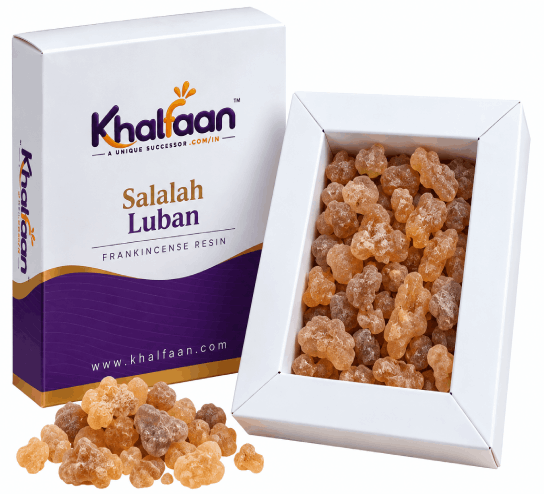
Our Salalah Luban presentation reflects the beauty and history of Omani frankincense.
With its natural resin appearance and thoughtfully designed packaging, Khalfaan Salalah Luban is an appealing choice for customers interested in traditional fragrances and natural products.
Whether you’re discovering Luban for the first time or reconnecting with a familiar Arabian tradition, Khalfaan brings this heritage closer to you.
Please refer to the product packaging for its confirmed origin, grade, intended uses, storage instructions and any consumption guidance.
To maintain the quality of frankincense resin:
Proper storage helps preserve the resin’s natural aroma and appearance.
It’s easy to look at a small piece of Luban and see only a natural resin.
But behind it lies the story of Omani landscapes, ancient trade routes, generations of traditional harvesting and a fragrance that has travelled across the world.
Today, Salalah Luban continues to interest people who appreciate natural aromas, traditional practices and Arabian heritage.
With Khalfaan Salalah Luban, you can discover that tradition and explore its uses responsibly.
Experience the Heritage of Salalah with Khalfaan.
From the Land of Frankincense to Your Home.
Salalah Luban is frankincense resin associated with the Salalah and Dhofar region of Oman. It is traditionally obtained from Boswellia sacra trees.
Certain food-grade frankincense resins are traditionally chewed. They may soften during chewing, but their texture is different from commercial chewing gum. Only chew products specifically approved for oral use.
Overnight soaking is a traditional preparation. However, only verified food-grade resin should be considered for this use, and the health benefits and safe daily quantities of homemade infusions have not been established.
Some edible-grade frankincense products are intended for oral use. Incense-grade resin should not be eaten. Follow the specific product’s instructions.
Traditional claims include digestive comfort and general wellness, but these benefits have not been established by high-quality clinical studies of Salalah Luban water.
Yes. Luban is the Arabic name commonly used for frankincense. Omani frankincense is particularly associated with Boswellia sacra.
Oman has a centuries-old frankincense trade history. Its importance is recognized through the UNESCO-listed Land of Frankincense in Dhofar.
Look for Khalfaan Salalah Luban on the Thijaara website, subject to current product availability.
Disclaimer: This article is for cultural and general informational purposes. Traditional uses are not medical recommendations. Khalfaan Salalah Luban should only be consumed if the specific batch is verified as food-grade and suitable for oral consumption. Consult a healthcare professional before using frankincense for health purposes.
